bill fontana's musical sculptures
the shadows of john cage
PARIS IN THE SURF
The first and principal difference between various sounds experienced by
our ear,
is that between noises and musical sounds.' Hermann Helmholtz
Meanwhile, everybody knows John Cage's 4’ 33’’: in 1952 pianist David
Tudor sat motionless down before a score where only blank measures were
notated. The intention was clear: the silence of art would make audible
the very noises that have always been banned from music – or to phrase
it with John Cage: ‘You could hear the wind stirring outside during the
first movement. During the second, raindrops began pattering the roof,
and during the third the people themselves made all kinds of interesting
sounds as they talked or walked out’.
The gesture with which Cage replaced the artificial sounds of music with
the natural sounds that surround us, can be considered as the symbol of
a trend that, from Russolo's 'Art of Noise' (1916) onward, surfaces time
and again in the course of the twentieth century. But, while figures
like Russolo introduced new instruments producing noise rather than
musical sounds, while figures like Kagel, Ligeti and
Nono managed to get
unusual sounds out of traditional instruments, and while figures like
Varèse used recordings of natural sounds as a starting point for a
composition, others, in the wake of John Cage, were rather interested in
ambient sound.
To the last group belongs Bill Fontana (° 1947). In 1994, on occasion of
the fiftieth anniversary of the landing in Normandy and the subsequent
liberation of Paris, he had the sound of the surf on the coast of
Normandy resound around the Arc de Triomphe in Paris. A remarkable
installation, called ‘ Sound Island’. From 1974 onward, Bill Fontana
continues to set up ever new - and always interesting - projects in
places all over the world: New York, San Francisco, Hawaii, Alaska, West
Berlin, Cologne, Paris, Amsterdam, Stockholm, Thailand, Australiia and
Japan (For a survey: visit his website).
ASSEMBLAGE
Bill Fontana’s projects are not just echoes from Cage's 4’33. In 'Sound
Islands', we do not hear the surf on the coast of Normandy, but in the
heart of Paris. Even when the concert hall is not precisely the place
where we use to hear the sound of the wind or the rain, there is no
veritable 'dépaysement' of the sound in Cage’s 4’ 33’’.
In that sense, Bill Fontana's creations have more in common with
Duchamp's ready-mades – or with André Breton's ‘objet trouvé’, which is
positively dislocated from its original context, and precisely owes its
status of ‘objet trouvé’ to such dislocation. By analogy, we could speak
of ‘sons trouvés’. Strictly speaking, a ‘son trouvé’ cannot but be the
rendering of an ambient noise or sound on another place. For sounds
cannot be just picked up and carried away like a pebble: they first have
to be captured by a microphone, transformed into electric signals and
transmitted to another place, where they have to be transformed into
sound again.
But Bill Fontana does more then merely relocate sounds. Already the
example of ‘Sound Island’ demonstrates that he carefully selects the new
context in which the sound is rendered. As a result, the hosting
location is affected - 'displaced' - in the first place.
That is why Bill Fontana’s creations have more in common with the
‘object surréaliste’ than with the ‘objet trouvé’ -certains objets
qu’on n’approche qu’en rêve (André Breton). On the understanding that,
with Bill Fontana, we are not dealing with the combination of two
visible objects - as when he had not transported the sounds of the
waves, but the waves themselves from the Atlantic Ocean to Paris:

The photomontage above - to be found on the website of Bill Fontana -
clearly shows in which tradition 'sound Islands' is to be placed and how
Bill Fontana contributes to its further development:the aural
appearance of one object is combined with the visual appearance of
another object. We are dealing here with a cross-sensitory ‘object
surréaliste’ (or assemblage) - or to phrase it in Bill Fontana own
words: with 'a transparent overlay to visual space'.
| object 1 |
aural | (- visual) |
| object 2 | (- aural) | visual |
Just like the surrealist
'objet trouvé' or 'object surréaliste', Bill Fontana's installation is a
genuine work of art: through the combination of an existing visual
object with an equally existing sound dislocated from its original
context and now conjuring up the representation of waves, an imaginary
world is created. And that imaginary world is all the more estranging
since it looms up in the middle of the real world.
SOUNDSCAPE (1)
In earlier creations like ‘Entfernte Züge’ (1983) - an echo of Pierre
Schaeffer's 'Etude aux chemins de fer' (1949) - the concept was far more
one-dimensional: sounds captured in the Köln Hauptbahnhof were rendered
on the ruins of the former ‘Anhalter Bahnhof’ in Berlin. Where formerly
real platforms with real passengers and real trains were to be seen, now
resounded the sounds from the busiest train station in Europe.

The effect must have been very estranging: to hear the sound of trains
and passengers without seeing them. Which certainly will have induced
the public to switch to the dimension of representation – and to conjure
up the visual reality that would have been there were the station not
destroyed in the end of the Second World War.
There is no question any more of an ‘objet surréaliste’, here in the
Berlin 'Entfernte Züge'. Rather are we dealing with pure, unbroken aural
mimesis: the conjuring up of an object or a world through providing
their aural appearance - as when in an old castle the sounds of hooves
and clang of arms were rendered to make the Middle Ages revive. Such
aural mimesis is not new: it has always been customary in the theatre,
as when the sound of thunder or of the wind are imitated. But the
possibilities increased dramatically as soon as sound recording was
invented. Even when the imitation of thunder has to be followed by an
imitation of lightning, as a rule, it suffices to provide the aural
appearance to conjure up the corresponding visual reality: when hearing
his voice in the radio, the face of the speaker; when hearing the
ringing of the bells of Rome, the sight of Saint Peter's square; when
hearing the crickets chirp, the Provence - and when hearing the sounds
of the Kölner Bahnhof, platforms with passengers under a huge iron and
glass vault
Although aural mimesis is art, it is not music: it would enter nobody's
mind to call the evocation of knights in a castle or the evocation of
trains in a station music. There is no doubt that also music conjures up
a world, but music proceeds in a totally different way (see: ‘Musical
space'). Hence, Bill Fontana’s creations are not a
revolutionary stride in the development of music. Rather do they revive
- if not bring to live - a nearly related branch of art that could only
truly develop through the invention of recording and electronic sound
production.
We now can better describe ‘Sound Island’ as a combination of an
existing visual object with aural mimesis. The difference with ‘Entfernte
Züge’ is only that the combination in ‘Sound Island’ is not ‘probable',
but 'surrealistic'. But only now do we fully realise that Bill Fontana
is doing more then merely relocating sounds: in the place where they now
resound, the accompanying visual representation is also conjured up. And
that goes not only for ‘Entfernte Züge’ in the Anhalter Bahnhof, but
also for ‘Sound Island’ in Paris: nobody has the impression that it is
cars that suddenly begin to produce the sounds of waves. Rather is the
visual perception of cars replaced with the representation of a sea,
just like the aural appearance of the waves is replacing the drone of
the cars.
The description ‘cross-sensitory assemblage’ applies only on the level
of the means. On the level of the world that is conjured up effectively
two worlds are combined, so that we have to remove the brackets here:
| object 1 | aural | visual |
| object 2 | aural | visual |
SOUNDSCAPE (2)
And that reminds us of the fact that, with Bill Fontana, the sounds
conjure up absent visual objects, while, with John Cage, the sounds
belong to present objects: the rain and the wind outside, the public in
the concert hall. It appears that we have to discern two kinds of
soundscape. Next to the soundscape that conjures up the accompanying
visual appearance - the evocative soundscape - we have the soundscape
that we hear when closing our eyes for visual appearances and when
listening to what there is to be heard here and now. Such real
soundscapes are the sound of the surf, thunder, the chirping of
crickets, the concert of birds in a wood - or the countless man-made
soundscapes: the market cries, the sound of hooting horns in a Southern
city, the soundscapes in stations and airports, the applause of the
public in a concert hall or the howling of football fans in a stadium -
not to mention the former intriguing sound of the train whistles in the
distance...
A particular variant of such real soundscapes are the creations of Bill
Fontana in which the sounds are relocated, but not so drastically that
it is no longer possible to see the visual sources of the sound. The
sound remains connected with its visual source. Such a soundscape is
‘Acoustical Views of Kyoto’ (1990) where ‘urban, religious and natural'
sounds are relocated to the top of a hill, from where one could see the
places where the sound originates. Bill Fontana describes the experience
as 'hearing as far as you can see'. A similar project is 'Acoustical
visions of Venice' (2000): 'whenever a bell rang or ship blew its horn,
one heard it first at the speed of light and then at the speed of
sound'. Also in 'Sound Island', there was a second installation on the
observation terrace of the monument inwhich 16 loudspeakers on the
perimeter played live sounds from locations in Paris that were more or
less visible.
This reminded me immediately of the marvellous passage in Nietzsche's ‘Morgenröthe’
where he describes how, amidst the raging of breakers on the rocks you
can see the sailing ship silently glide over the waves, whereas amidst
the howling of the wind in the rigging and the sails, the breakers seem
to silently rage against the cliffs. Imagine Bill Fontana relocating the
sound of the wind in the sails to the coast. Even Nietzsche's 'Schein'
would then have disappeared from the world...
And this is to the point! For, although the world is transformed
'Acoustical Views of Kyoto’, no imaginary world emerges. No art is being
made here, but a sensitory refined world, a world wherein the thunder
would resound together with the lightning. A similar refined world, but
then within one and the same sense, is obtained through the lighting of
rooms when it is dark: that equally creates a new world, but a world
that is real, just like the sound that Bill Fontana is relocating,
albeit with the speed of electric signals..
SOUNDSCAPE (3)
And that brings us to a third kind of soundscape: next to the evocative
and the real (natural or urban) soundscape, there is also the soundscape
the sounds of which are deliberately produced, not to conjure up an
imaginary world, but to mould the real world to human needs and tastes.
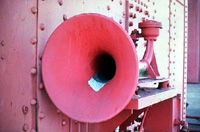
With regard to soundscapes, we can refer to mist horns that have to
signal sandbanks and cliffs when lighthouses are no longer visible. Or -
to give somewhat less prosaic examples: the drums and trumpets in
profane and religious processions, hunting horns, the ringing of bells
over the city, peals of cannonade, the blowing of ship horns on New
Year's eve, and what have you. We are not dealing with art here:
although sounds are produced, like in music and evocative soundscapes,
these sounds do not conjure up imaginary worlds, theythemselves are the
world intended. We are dealing with aural or acoustic design - the
audible counterpart of the architectural design of avenues, squares and
buildings.
It is apparent from our examples that such acoustic design is not at all
an invention of our age. Rather can we ask ourselves why acoustic design
seems to stick so stubbornly to archaic technology. There are scarcely
any new creations, and even these prefarably resort to antiquated
technology: think of Györgi Ligeti's ‘Poème symphonique’ for 100
metronomes (1962) - a modest soundscape, confined within the walls of
the concert hall. With far more powerful and far more diverse sources of
sound than mist horns or train whistles, gigantic computer directed
aural architectures could be conceived: the high-technological heirs to
the bells ringing over medieval towns, the audible counterparts of the
accompanying gothic cathedrals - this time built over vast cities,
extended lakes, nocturnal deserts, in the mountains - and why not in the
Grand Canyon! Would not that be great!
Let us give a survey in the following table:
| art | design | ||
| imaginary world | real world | ||
| music | aural mimesis | aural reality | aural design |
| evocative soundscape1 |
evocative soundscape2 |
designed soundscape 3 |
|
BABEL
And we can equally ask ourselves why this elementary insight in the
existence of four kinds of aural worlds - and three kinds of soundscape
- has not penetrated the contemporary art world and the accompanying
philosophy. Quite the contrary: everything seems to be messed up here...
That is already apparent from terms like 'musical sculpture' that Bill
Fontana uses to designate his creations. No doubt, the introduction of a
sound affects the surrounding environment no less that the erection of a
sculpture. But the effect is rather different. And, when we overlook
that difference, why not speak of 'sonic' sculptures: why compare the
sound of waves and the sounds in a station with music? Otherwise, Bill
Fontana often designates his creations more generally as 'acoustic art',
which would no doubt be nearer the truth, were it not that he equally
uses the term 'acoustic design' as if art and design - the creation of
an imaginary world versus the transformation of the real world - should
be one and the same thing. And he would justifiably remark that 'it is
only very recently that the concept of sound design and soundscape have
even existed', were it not for the fact that the soundscapes he creates
do not belong to the third kind of designed soundscapes - to genuine
'acoustic design'.
Conversely, Bill Fontana's eagerness to inscribe himself in the
tradition of music prevents him form assigning his work its real place
in the history of art: creations like 'Sound Island' are rooted in the
tradition of the 'object surréaliste' to which Bill Fontana contributes
in making it cross-sensory and in increasing the scale. A description
like ''a transparent overlay to visual space' only obscures such
insight.
THE SHADOWS OF JOHN CAGE
"Try as we may to make a silence, we cannot...One need not fear for the
future of music.John Cage.
And it is here that the gesture with which we had John Cageintroduce
our essay, reveals its historic truth - and the accompanying
philosophies of art their historic untruth. For artists like Bill
Fontana, John Cage's 4' 33'' have merely functioned as an alibi to,
under the guise of revolutionising music, let music for what it is while
proceeding to the development of another - and, apart from primitive
forerunners: new - branch of art: aural mimesis.
Such false consciousness has its costs. It is not difficult to see that
the development of the vast domain of aural mimesis would have fared
better, had it had from the beginning been understood as the development
on a higher level of the traditional techniques of producing sounds in
the coulisses of the theatres, and not as a revolutionary stride in the
development of music. And, had art and design not been hopelessly messed
up, we surely would have witnessed the far more important development of
a genuine high-tech aural design as described above.
Also music would have fared better. the development of an autonomous
aural mimesis alongside music(al mimesis) would only have fostered the
consciousness that, even when in both cases they have to be 'composed',
ordinary sounds and noises have to be treated totally different then
musical sounds (tones). And only the development of a genuine sonic
design would, on top of that, have made it fully clear that there is a
difference between imaginary musical space and real aural space (see
'Musical space'). We would have been spared
countless halfway creations and we could have witnessed the creation of
lots of full-blooded artworks - including all kinds of well-thought-out
combinations...
Even when Bill Fontana is not a revolutionary of music, then, he is
surely a pioneer in a domain with a promising future. And we can only
advise the reader to get acquainted with his work on his website - where
also the permanent installations are mentioned.
After all, it does not matter what one thinks or says, but what one
does.
© Stefan Beyst, August 2004.
referrers:
the artist.org
Classical Composers Database
Stefan Drees
Jenefer
Harrison


image of the week:


